The Biggest Misunderstanding About Phuket Rain
For many travelers, the phrase Phuket rainy season immediately creates a very specific mental image: dark skies, constant downpours, flooded streets, cancelled tours, and entire holidays spent trapped indoors waiting for storms to pass.
That perception is understandable — especially when people search online and see dramatic monthly rainfall totals attached to Phuket’s wet season. A chart showing “300mm of rain” in a single month sounds intimidating if you have no context for how tropical rainfall actually behaves.
But there is a major problem with the way most weather information is presented to travelers.
Rainfall totals alone don’t explain:
- when the rain happens,
- how long it lasts,
- whether it falls overnight,
- or how much of the day remains usable for beaches, cafés, sightseeing, or island tours.
And that distinction matters far more than most people realize.
This is one of the biggest reasons travelers often misunderstand the Phuket rainy season before arriving. Many visitors assume wet season automatically means nonstop rain all day, every day — when the reality is usually much more nuanced. Similar expectation gaps appear in many parts of the planning process, especially for first-time visitors trying to interpret tropical destinations from simplified travel summaries. Phuket Mistakes First Timers Make and Real Phuket vs Instagram Phuket: What Visitors Should Expect both touch on how online perceptions of Phuket often differ from what travelers experience on the ground.
To better understand how Phuket rain actually behaves, we analyzed hourly weather observations recorded at Phuket International Airport throughout 2025. But instead of focusing on total rainfall volume alone, we looked specifically at meaningful rainfall hours — periods where rainfall reached at least 1mm within an hour.
That distinction is important.
Tiny trace moisture readings or brief drizzles often have very little impact on travelers. A humid tropical island can register small precipitation values without materially affecting beach time, transport, sightseeing, or general holiday usability. What travelers usually care about is when meaningful rain occurs and whether it dominates the day.
The results turned out to be far more interesting than the usual “wet season vs dry season” narrative.
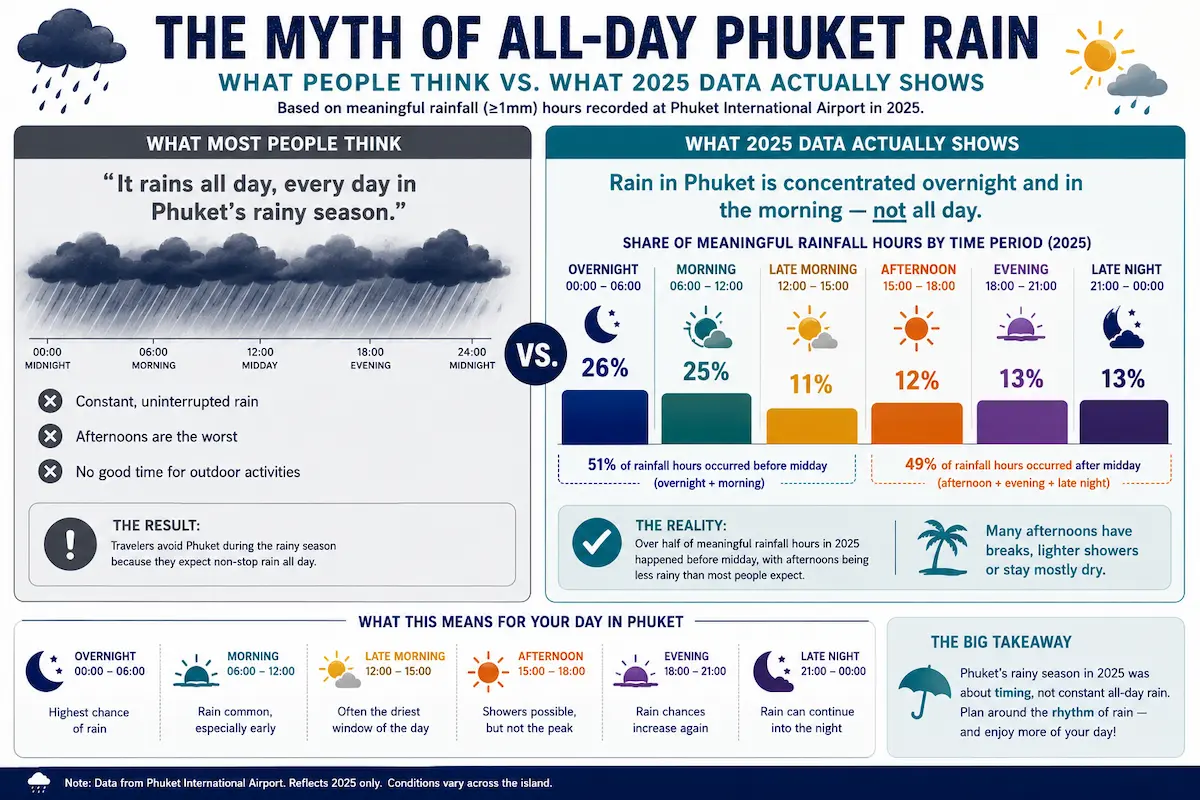
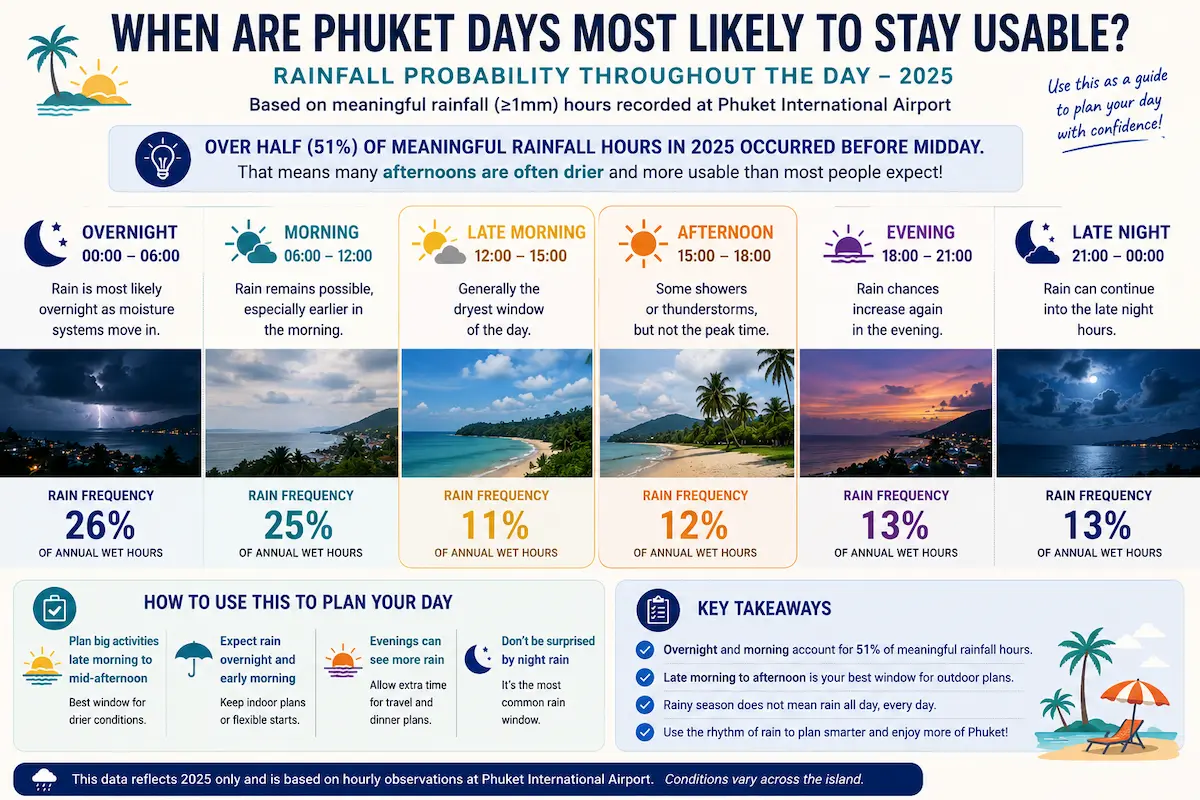
Across the full 2025 dataset, over half of all meaningful rainfall hours occurred before midday — with overnight and morning periods accounting for the largest concentration of rainfall activity overall.
That does not mean Phuket mornings are always rainy, nor does it mean afternoons stay permanently dry. Tropical weather remains highly variable, especially during the Phuket monsoon season. However, the data strongly suggests rainfall timing patterns are far more complex than the idea of uninterrupted all-day rain.
This becomes especially important for travelers planning activities, tours, beach time, or island hopping experiences. Understanding when rain tends to occur can often be more useful than simply knowing how much rain falls during a month.
And psychologically, this changes how many people should think about Phuket weather in rainy season altogether.
Instead of viewing wet season as a constant weather event, it may be more accurate to think of Phuket rain as a rhythm — periods of moisture, changing skies, overnight systems, tropical instability, and shifting usable windows throughout the day.
That rhythm becomes much clearer once the hourly rainfall patterns are visualized properly.
What the 2025 Phuket Rainfall Data Actually Showed
Most Phuket weather guides rely on broad monthly rainfall averages. While those numbers are useful for understanding general seasonal patterns, they rarely explain how rain actually behaves throughout the day.
A month showing “high rainfall” does not automatically mean travelers will experience nonstop rain from morning until night. In tropical destinations like Phuket, rainfall timing often matters far more than rainfall totals alone.
To better understand that timing, we analyzed hourly weather observations recorded at Phuket International Airport across the entire 2025 calendar year. Rather than simply measuring total rainfall volume, the analysis focused on meaningful rainfall hours — defined as any hour recording at least 1mm of rainfall.
This threshold was chosen intentionally.
Tiny trace precipitation values can occur frequently in tropical climates without materially affecting outdoor plans. Short-lived drizzle, brief moisture spikes, or isolated light showers often have very little impact on beach conditions, transport, sightseeing, or day-to-day travel experiences. By focusing on meaningful rainfall periods instead, the data becomes much more useful from a traveler perspective.
The results revealed something many visitors would probably not expect.
Across the full 2025 dataset, Phuket recorded:
731 meaningful rainfall hours
spread across the year.
At first glance, that may still sound significant. But context matters enormously here.
A full calendar year contains:
- 8,760 total hours.
That means meaningful rainfall occurred during roughly:
8.3% of all hours throughout 2025.
That statistic alone already paints a very different picture from the common assumption that Phuket rainy season means constant all-day storms for months at a time.
But the most interesting insight appeared when those rainfall hours were grouped by time of day.
The annual timing distribution looked like this:
| Time Period | Meaningful Rainfall Share |
|---|---|
| Overnight (00:00–06:00) | 26% |
| Morning (06:00–12:00) | 25% |
| Late Morning (12:00–15:00) | 11% |
| Afternoon (15:00–18:00) | 12% |
| Evening (18:00–21:00) | 13% |
| Late Night (21:00–00:00) | 13% |
The biggest surprise was immediately obvious.
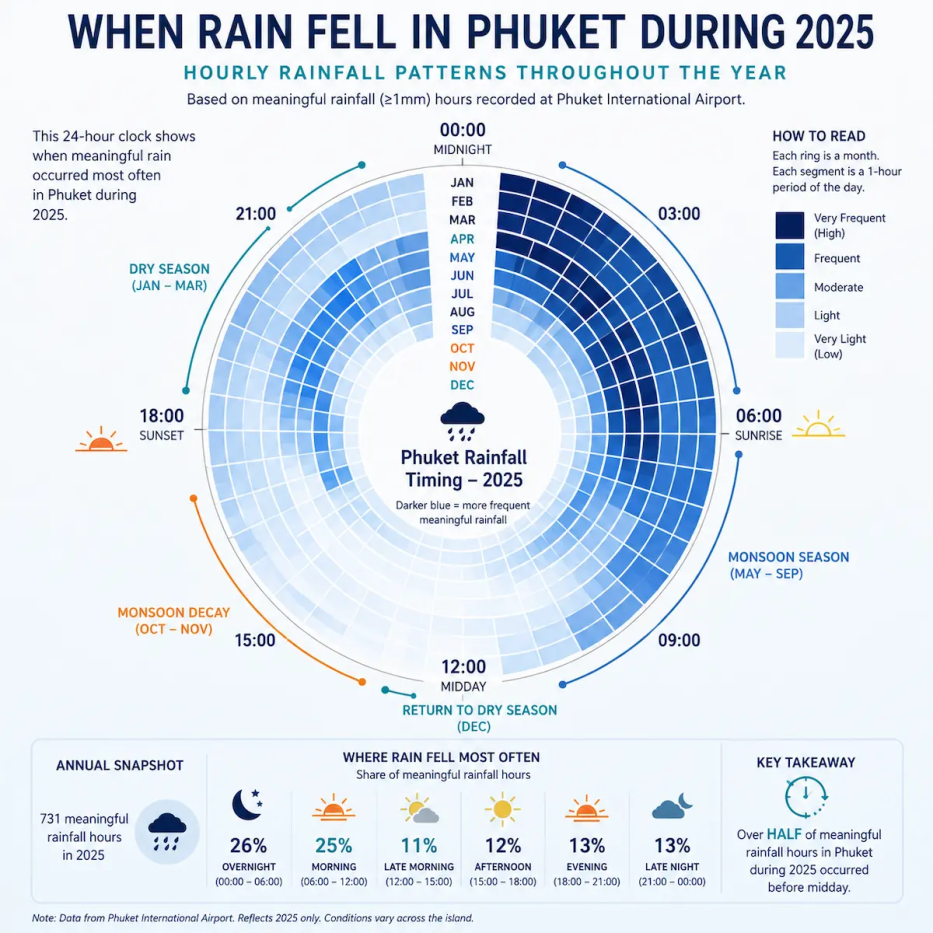
Over half of all meaningful rainfall hours occurred before midday.
That finding strongly challenges one of the most common assumptions travelers make about Phuket weather.
Many people imagine tropical rainfall as:
- constant afternoon thunderstorms,
- rain building steadily all day,
- or entire afternoons becoming unusable during wet season.
But the 2025 observational data suggested something much more nuanced.
Instead, meaningful rainfall was concentrated most heavily during:
- overnight periods,
- early mornings,
- and broader overnight-to-morning moisture windows.
Meanwhile, late morning and afternoon rainfall activity was often lower than many travelers would expect — even during monsoon season months.
This does not mean Phuket afternoons are always sunny during rainy season. Tropical weather remains highly unpredictable, and storm systems can absolutely develop at any time of day. However, the data suggests the idea of nonstop all-day rain is often exaggerated when discussing Phuket monsoon season.
This timing behavior becomes especially important for practical trip planning.
Travelers researching Best Time to Visit Phuket or reading broader guides like Phuket Weather by Month: A Practical Planning Guide are often trying to answer very practical questions:
- Will beach time still be possible?
- Are island tours constantly cancelled?
- Does rain normally last all day?
- Is rainy season still enjoyable?
Those questions are difficult to answer using monthly rainfall totals alone.
Hourly timing patterns tell a much more useful story.
For example, several monsoon-season months in 2025 showed rainfall concentrated heavily overnight while afternoons remained comparatively lighter than expected. Other periods showed broad overnight moisture systems followed by improving daytime conditions later in the day.
This helps explain why many travelers arrive during Phuket rainy season and discover the experience feels very different from what they imagined beforehand.
The weather often behaves more like:
- changing windows,
- intermittent systems,
- periods of rain followed by usable conditions,
rather than continuous uninterrupted storms.
And importantly, those patterns also shifted significantly throughout the year.
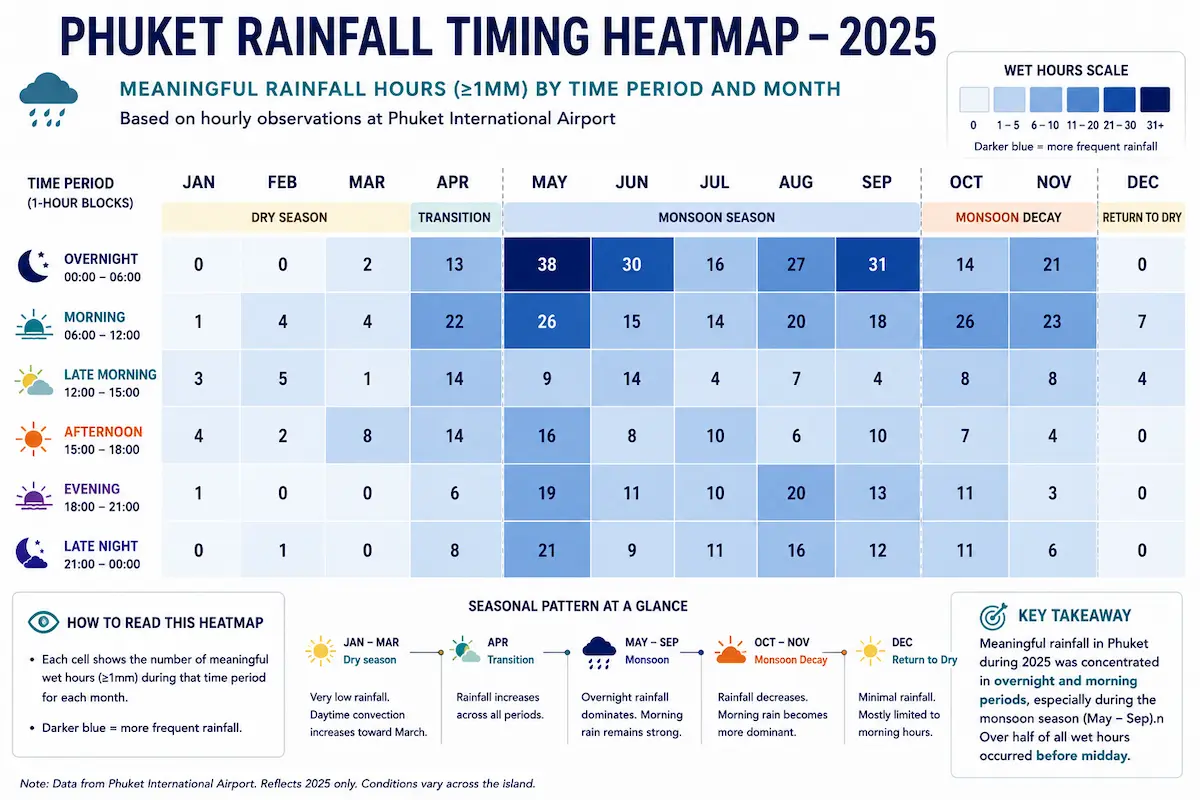
Dry season months behaved very differently from transition months, while monsoon months developed their own distinct rainfall rhythm altogether. That seasonal evolution becomes much clearer once the data is viewed month-by-month rather than as a single annual average.
How Phuket Rain Changes Through the Year
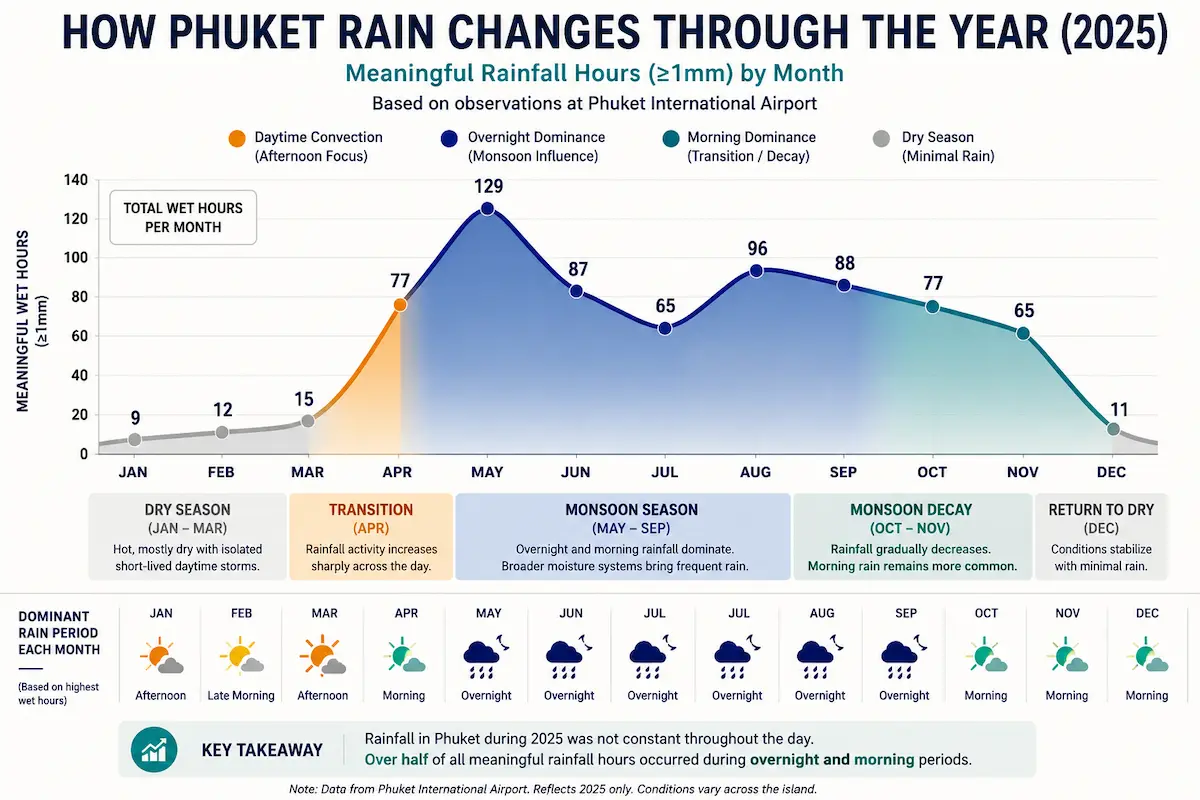
One of the most revealing parts of the 2025 rainfall analysis was not simply how much rain fell — but how dramatically rainfall behavior changed throughout the year itself.
This is where many simplified Phuket weather guides become misleading.
A single phrase like “wet season” often creates the impression that Phuket experiences the same type of weather continuously for several months straight. But the hourly rainfall data showed something much more dynamic.
The island’s weather rhythm evolved gradually across the year:
- dry season behaved one way,
- transition months behaved another,
- and monsoon months developed their own distinct rainfall timing patterns.
Understanding those seasonal shifts is far more useful than simply memorizing average rainfall totals.
January to March — Dry Season Stability
The first three months of 2025 behaved exactly how many travelers hope Phuket will feel.
Rainfall activity remained extremely low overall:
- January recorded only 9 meaningful rainfall hours,
- February recorded 12,
- March recorded 15.
Across these months, rain was generally:
- isolated,
- short-lived,
- and primarily daytime-based.
Afternoon rainfall showed the strongest presence during this phase, especially in March, where daytime heat and humidity likely contributed to isolated tropical convection.
Importantly, overnight rain was almost nonexistent during early-year dry season months.
That matters because it reveals something psychologically important about Phuket dry season:
- rainfall is not only lower overall,
- but atmospheric moisture systems themselves behave differently.
Instead of broad overnight monsoon systems, the island experiences more localized daytime instability.
This aligns closely with why many travelers consider this period the Best Time to Visit Phuket, particularly for:
- beach-focused holidays,
- island hopping,
- snorkeling trips,
- and consistent sightseeing conditions.
But even here, the data still reinforces an important point:
Phuket is tropical year-round. Completely rain-free conditions are never guaranteed.
April — The Transition Month
April was where the weather behavior changed dramatically.
Meaningful rainfall hours jumped sharply:
- from 15 hours in March
- to 77 hours in April.
That increase was enormous.
And unlike the earlier dry-season months, rainfall no longer remained isolated to narrow daytime windows. Instead, rain began spreading across:
- overnight,
- morning,
- afternoon,
- and evening periods.
This is where Phuket started behaving less like a stable dry-season destination and more like a tropical environment entering seasonal transition.
Interestingly, April’s strongest rainfall concentration occurred during morning hours rather than afternoons.
That finding was particularly fascinating because many travelers assume tropical rain simply builds toward afternoon thunderstorms. But Phuket’s seasonal transition appeared more complex than that in 2025, with broader atmospheric moisture patterns becoming increasingly influential.
This also helps explain why many people remembered Songkran 2025 as unusually wet.
The data strongly supports the idea that April represented the visible turning point into Phuket’s wetter seasonal cycle.
May to September — Monsoon Phase
By May, the rainfall behavior shifted again.
This was the point where overnight rainfall became consistently dominant.
May recorded:
129 meaningful rainfall hours
making it the wettest month in the entire dataset.
But once again, the timing pattern mattered more than the total alone.
The strongest rainfall concentrations during May occurred:
- overnight,
- early morning,
- and late-night periods.
That pattern continued surprisingly consistently throughout:
- June,
- July,
- August,
- and September.
This became one of the strongest findings in the entire project.
Contrary to the simplistic idea of nonstop daytime storms, Phuket monsoon season in 2025 often behaved more like:
- overnight moisture systems,
- broad monsoon rain bands,
- and shifting weather windows throughout the day.
Meanwhile, afternoon rainfall remained lower than many travelers would probably expect.
In fact, several monsoon months showed surprisingly subdued afternoon rainfall totals compared to overnight periods.
This does not mean rainy season afternoons are reliably sunny. Weather conditions during Phuket monsoon season remain highly variable, and storm systems can absolutely disrupt tours, beaches, or travel plans.
However, the data strongly suggests the experience is often more nuanced than the phrase “rain all day every day” implies.
Many days likely contained:
- usable weather windows,
- periods of clearing,
- changing skies,
- or rain concentrated outside peak daytime activity periods.
That distinction matters enormously for travelers deciding whether rainy season is worth considering at all.
For some visitors, the green season can still offer:
- quieter beaches,
- lower hotel prices,
- softer landscapes,
- dramatic skies,
- and more relaxed travel pacing.
Articles like Phuket Dry Season vs Green Season: Which Is Better for Your Trip? explore that tradeoff in much more detail, especially for travelers trying to balance weather reliability against crowd levels and pricing.
October and November — Monsoon Decay
Interestingly, October and November did not behave like escalating monsoon chaos.
Instead, the rainfall patterns suggested gradual seasonal softening.
Total meaningful rainfall hours declined compared to May’s peak levels, while rainfall timing shifted again toward:
- overnight,
- morning,
- and early-day periods.
Afternoon rainfall weakened even further during these months.
That finding is especially important because October is often portrayed online as one of Phuket’s most difficult weather months. While storms and rough sea conditions certainly remain possible, the hourly timing analysis suggests rainfall was still concentrated into particular periods rather than dominating the entire day continuously.
This is exactly why understanding Phuket weather by month requires more than simple rainfall totals.
Rainfall behavior itself changes throughout the year.
And that behavior influences:
- how the island feels,
- how usable days remain,
- and how travelers psychologically experience Phuket rainy season altogether.
December — Return to Dry Season
By December, the pattern shifted back toward classic dry-season behavior.
Rainfall totals dropped sharply again:
- only 11 meaningful rainfall hours were recorded across the month.
Overnight and evening rain virtually disappeared, while the remaining rainfall activity became lightly concentrated around morning and late-morning periods.
The seasonal cycle had effectively reset.
And importantly, this final transition reinforces one of the article’s central conclusions:
Phuket rain is not static.
It evolves through seasonal rhythms, changing atmospheric patterns, and shifting timing behaviors throughout the year.
Why Phuket Rain Behaves Differently by Season
One of the most surprising discoveries in the 2025 rainfall analysis was not simply how much rain fell during Phuket rainy season — but how differently the rain behaved depending on the time of year.
This is an important distinction because many travelers think about tropical weather too simplistically.
People often imagine Phuket rain as a single repeating pattern:
- clouds build,
- afternoon storms arrive,
- heavy rain lasts for hours,
- then the cycle repeats every day.
But tropical weather systems are much more complex than that.
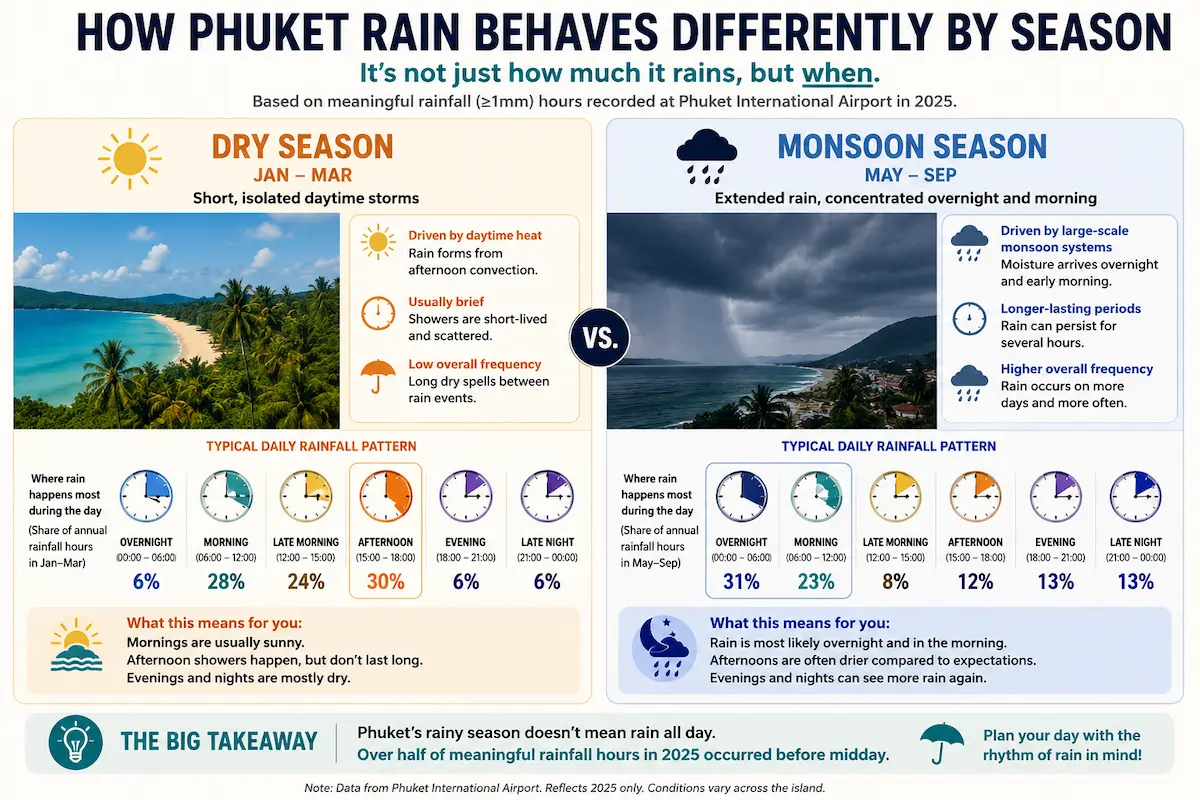
The hourly rainfall data from 2025 revealed that Phuket experienced several distinct rainfall behaviors across different phases of the year:
- dry-season convection,
- transition instability,
- monsoon moisture flow,
- and monsoon decay.
Each one created very different daily weather rhythms.
Dry Season Rainfall Behaves Like Isolated Tropical Instability
During the early dry-season months:
- January,
- February,
- and March,
meaningful rainfall remained very limited overall.
But when rain did occur, it was more likely to appear during:
- late morning,
- afternoon,
- or isolated daytime periods.
This type of weather is often driven by localized tropical heat buildup.
As humidity rises during the day:
- warm air lifts,
- clouds develop,
- and isolated showers or thunderstorms can form temporarily before conditions stabilize again.
This is why dry-season rain in Phuket often feels:
- brief,
- scattered,
- and highly localized.
One beach may experience a short burst of rain while another part of the island remains mostly dry.
This also explains why many travelers visit during dry season and still occasionally encounter showers despite hearing that conditions are “perfect.”
Tropical islands rarely become completely rain-free.
Even during Phuket’s most stable weather periods, isolated convection can still occur.
Monsoon Rain Behaves More Like Broad Moisture Systems
By contrast, the rainfall behavior during Phuket monsoon season looked very different.
From May onward, the strongest rainfall concentrations shifted toward:
- overnight,
- morning,
- evening,
- and late-night periods.
That timing pattern strongly suggests the influence of broader regional moisture systems rather than isolated daytime heating alone.
This is where many travelers misunderstand Phuket rainy season.
Monsoon weather does not necessarily mean:
- nonstop visible storms every afternoon,
- or constant rain covering the island uniformly all day.
Instead, the weather often behaves more like:
- waves of atmospheric moisture,
- shifting rain bands,
- overnight rainfall surges,
- periods of clearing,
- and changing conditions throughout the day.
This helps explain why many visitors arrive during wet season and discover the experience feels less catastrophic than they imagined beforehand.
There may still be:
- beach windows,
- usable afternoons,
- café time,
- sightseeing opportunities,
- or periods where weather improves temporarily between rain systems.
At the same time, monsoon season absolutely brings:
- rougher seas,
- higher humidity,
- changing marine conditions,
- and less predictable outdoor planning.
This becomes especially important for travelers planning:
- island hopping,
- snorkeling tours,
- ferry travel,
- or exposed coastal activities.
Guides like Phuket Day Trip Guide: Which Tours Are Actually Worth It? and Phi Phi Islands Tour become particularly useful during wetter periods because weather flexibility matters much more than during stable dry-season months.
Phuket Rain Often Feels Worse Psychologically Than It Actually Is
Another fascinating aspect of tropical weather is psychological perception.
Heavy rain in Phuket can feel extremely dramatic in the moment:
- skies darken quickly,
- tropical downpours become intense,
- roads flood temporarily,
- thunder echoes across the island,
- and visibility changes rapidly.
For travelers unfamiliar with tropical climates, this can create the impression that conditions will remain bad for the rest of the day.
But tropical rainfall often behaves in pulses rather than continuous systems.
A strong overnight storm or a violent 45-minute downpour can psychologically dominate someone’s memory of an entire day — even if several usable weather windows appeared before or afterward.
This is one reason online discussions about Phuket weather can become so polarized.
Some travelers visit during rainy season and report:
“It rained every day.”
Others visit during the exact same period and say:
“The weather was mostly fine.”
Both experiences can technically be true.
Because tropical weather is highly variable not only across weeks and months, but often across individual hours.
Understanding Rain Timing Matters More Than Rain Totals
This is ultimately the biggest lesson from the 2025 data.
Understanding:
- when rain tends to occur,
- how rainfall behavior changes seasonally,
- and what type of rainfall patterns dominate,
is often far more useful than simply reading monthly rainfall totals in isolation.
That’s especially true for travelers planning:
- slower trips,
- flexible itineraries,
- café-heavy days,
- relaxed beach schedules,
- or mixed activity holidays.
In many cases, Phuket rainy season is less about permanent bad weather and more about learning how tropical weather rhythms actually behave.
When Phuket Days Are Most Likely to Stay Usable
One of the biggest fears travelers have before visiting Phuket during rainy season is losing their entire holiday to bad weather.
People imagine:
- beaches permanently washed out,
- tours constantly cancelled,
- dark skies lasting all day,
- and long periods trapped indoors waiting for storms to pass.
But the 2025 rainfall timing data suggests the reality is often much more flexible than many first-time visitors expect.
That does not mean Phuket rainy season is “dry.” It absolutely is not.
Heavy rain, rough seas, unstable skies, and disruptive weather systems remain very real parts of the island’s wetter months. Ferry delays, cancelled snorkeling tours, and poor swimming conditions can absolutely occur during monsoon season.
However, the hourly rainfall analysis strongly suggests many days still contain usable windows — even during wetter periods of the year.
And importantly:
those usable windows often appear during parts of the day travelers assume will be worst affected.
Overnight Rain Changes the Psychology of Wet Season
One of the strongest findings in the dataset was the dominance of overnight and morning rainfall during monsoon months.
That matters enormously from a traveler perspective.
If rain falls primarily:
- overnight,
- during sleep hours,
- or early in the morning,
then the practical impact on daily activities can sometimes be lower than travelers imagine when reading monthly rainfall totals online.
A violent tropical downpour at 2am contributes heavily to monthly rainfall statistics — but it does not necessarily ruin beach time, cafés, sightseeing, or dinner plans the following afternoon.
This is one reason rainy season experiences vary so dramatically between travelers.
Some visitors remember:
- dramatic overnight storms,
- changing skies,
- occasional interruptions,
- and short bursts of intense rain.
Others interpret the same conditions as:
“It rained nonstop.”
Tropical weather tends to feel emotionally bigger than its actual hourly duration.
Late Morning and Afternoon Were Often More Usable Than Expected
Another fascinating finding from the 2025 analysis was how relatively subdued late morning and afternoon rainfall remained throughout much of the wetter season.
This was particularly surprising because many people instinctively associate tropical climates with constant afternoon thunderstorms.
But during several monsoon months, meaningful rainfall activity remained more concentrated in:
- overnight,
- early morning,
- evening,
- and late-night periods.
That does not guarantee dry afternoons.
But it does suggest many travelers may overestimate how consistently daytime hours become unusable during Phuket monsoon season.
This helps explain why some rainy-season visitors still manage to enjoy:
- beach walks,
- cafés,
- markets,
- viewpoints,
- massages,
- food tours,
- or relaxed sightseeing,
even during wetter months.
Flexible planning becomes much more important than trying to force rigid schedules.
That’s especially true for visitors building slower itineraries or balancing weather-sensitive activities across multiple days. Guides like How Many Days in Phuket and Phuket for Slow Travel: Building a More Relaxed Trip become particularly useful during rainy season because additional flexibility often improves the overall experience dramatically.
Phuket Rain Often Arrives in Pulses Rather Than Constant Storms
Another reason Phuket days can remain surprisingly usable is because tropical rain often behaves in bursts.
A storm may:
- build quickly,
- release heavy rain intensely,
- then clear or weaken again within relatively short periods.
This creates:
- changing skies,
- intermittent usable windows,
- and constantly shifting conditions.
Travelers expecting European-style weather systems sometimes misunderstand this dynamic completely.
In many temperate climates, rain arriving often means:
- grey skies for the entire day,
- stable low-pressure systems,
- and persistent wet conditions.
Phuket’s tropical weather frequently behaves differently.
Conditions can shift rapidly within a single afternoon:
- blue sky,
- sudden storm,
- sunlight returning,
- another passing shower,
- then calm evening conditions later.
That unpredictability is part of what makes tropical weather feel so dramatic — but also why rainy season does not automatically destroy entire travel days.
Flexibility Matters More Than Perfection
Ultimately, travelers who enjoy Phuket rainy season most successfully are usually the ones who stop expecting perfect uninterrupted weather every day.
Instead, they approach the island with:
- more flexibility,
- slower pacing,
- adaptable planning,
- and realistic expectations.
That mindset often changes the experience completely.
Rather than trying to control the weather, travelers begin working with the island’s rhythm:
- adjusting beach time around conditions,
- using storms as café breaks,
- exploring markets during rain,
- or slowing down naturally when skies become unstable.
This is also why location choice matters more during wetter months. Areas with strong café culture, restaurants, walkability, and varied indoor options often feel much easier during unstable weather periods. Articles like Phuket Areas Explained: Choosing the Right Base for Your Holiday and Why Hotel Location Changes Your Entire Phuket Experience become especially relevant once weather flexibility enters the equation.
And perhaps most importantly:
the 2025 data strongly suggests Phuket rainy season is rarely as psychologically overwhelming as many first-time visitors fear before arriving.
What Travelers Often Get Wrong About Phuket Rain
One of the most interesting things about Phuket weather is how emotionally distorted online conversations about rainy season can become.
Search almost any travel forum discussion about Phuket monsoon season and you’ll usually find two completely opposite opinions appearing side by side.
One traveler says:
“It rained every single day.”
Another says:
“The weather was mostly fine.”
At first glance, those experiences sound contradictory.
But after analyzing Phuket’s 2025 rainfall timing patterns, it becomes much easier to understand why both people may genuinely believe they are telling the truth.
Tropical weather is highly psychological.
A violent overnight thunderstorm, an intense one-hour downpour, or a dramatic dark sky rolling across the beach can dominate someone’s memory of an entire day — even if several usable hours existed before or afterward.
And because tropical storms often feel visually dramatic:
- loud rain,
- sudden darkness,
- thunder,
- flooding roads,
- rough seas,
- and fast-changing skies,
the emotional impression can become much larger than the actual rainfall duration itself.
This is especially true for first-time tropical travelers.
People arriving from colder or temperate climates often expect rain systems to behave the same way they do back home:
- once rain begins,
- it usually stays grey,
- cold,
- and wet for the rest of the day.
But Phuket weather in rainy season often behaves differently.
Conditions may:
- change rapidly,
- clear temporarily,
- shift between sunshine and storms,
- or move unevenly across different parts of the island.
One beach can be soaked while another area remains relatively dry only 20–30 minutes away.
That unpredictability is part of why Phuket rainy season is often misunderstood online.
Another major misunderstanding is the assumption that rainfall totals automatically translate into ruined holidays.
A monthly rainfall chart might look intimidating on paper, but rainfall volume alone does not explain:
- timing,
- duration,
- concentration,
- or daily usability.
That is exactly why the 2025 hourly rainfall analysis became so revealing.
The data suggested:
- meaningful rainfall occurred during only a relatively small percentage of total annual hours,
- overnight and morning periods dominated much of the wetter season,
- and late morning or afternoon rainfall was often less severe than many travelers assume.
That does not mean travelers should ignore seasonal reality.
Rainy season still brings:
- rougher marine conditions,
- occasional flooding,
- stronger storms,
- dangerous swimming days,
- and more volatile weather behavior overall.
But it does suggest the reality is usually far more nuanced than the phrase:
“It rains all day every day.”
And honestly, that nuance matters.
Because understanding Phuket weather properly helps travelers make better decisions:
- choosing slower itineraries,
- allowing flexibility,
- selecting the right beach areas,
- balancing tours with downtime,
- and setting realistic expectations before arrival.
Articles like First-Time Phuket Guide, Phuket for First-Time Visitors: What People Get Wrong Before Arriving, and Phuket Travel Tips Nobody Tells You Before Visiting all touch on similar themes:
Phuket is often misunderstood when viewed through overly simplified travel narratives.
The weather may be one of the clearest examples of that misunderstanding.
And once you begin looking at rainfall through timing, rhythm, and seasonal behavior rather than just raw totals, Phuket rainy season starts to look very different altogether.
Final Thoughts — Phuket Rain Is About Rhythm, Not Constant Storms
After analyzing Phuket’s hourly rainfall behavior throughout 2025, one conclusion became very clear:
Phuket rain is far more about timing and rhythm than nonstop all-day storms.
That does not mean rainy season should be ignored or underestimated. Tropical weather remains unpredictable, and monsoon months absolutely bring:
- heavier moisture systems,
- rougher seas,
- stronger storms,
- and more unstable travel conditions overall.
But the data also strongly suggests the experience is often far more nuanced than many travelers expect before arriving.
Instead of continuous uninterrupted rain dominating every hour of the day, the 2025 observations showed:
- meaningful rainfall frequently concentrated overnight,
- mornings carried a large share of rainfall activity,
- and many daytime periods remained more usable than the phrase “wet season” often implies.
That distinction matters enormously for trip planning.
Because understanding:
- when rain tends to occur,
- how weather behavior changes seasonally,
- and what type of rainfall patterns dominate,
is often far more useful than simply looking at monthly rainfall totals alone.
Ultimately, Phuket rainy season is not a single uniform experience.
January behaves differently from May.
May behaves differently from September.
And September behaves differently from November.
The island moves through changing weather rhythms across the year:
- dry-season stability,
- transitional tropical instability,
- overnight monsoon systems,
- and gradual seasonal softening.
For travelers willing to approach Phuket with:
- realistic expectations,
- flexibility,
- slower pacing,
- and an understanding of tropical weather behavior,
rainy season can still be an incredibly rewarding time to experience the island.
And perhaps that is the biggest misunderstanding of all:
Phuket weather is rarely just about rain itself.
More often, it is about learning how to travel with the rhythm of the island rather than fighting against it.
Planning a Phuket Trip?
If you’re still deciding when to visit, where to stay, or how to structure your time around Phuket’s changing weather patterns, our free Phuket travel guide breaks down the island in a much more practical and realistic way — including beach areas, travel pacing, transport, seasonal considerations, and common planning mistakes first-time visitors often make.
👉 Download the free Phuket planning guide from Resurgence Travel and start building a trip that fits your travel style, not just the weather forecast.
Data Source & Methodology
This analysis was based on hourly weather observations recorded at Phuket International Airport during 2025 using Meteostat historical weather data. Meaningful rainfall hours were defined as periods recording at least 1mm of rainfall within an hour to better reflect practical traveler impact rather than trace precipitation alone.
Readers interested in exploring the underlying observational weather data can view the Meteostat historical dataset here:
👉 Meteostat Historical Weather Data
Frequently Asked Questions About Phuket Rainy Season
Does it rain all day in Phuket during rainy season?
Usually, no.
The 2025 hourly rainfall analysis showed meaningful rainfall often occurred during specific periods of the day rather than continuously across every daytime hour. Overnight and morning rainfall were particularly common during wetter months, while some afternoons remained more usable than many travelers expect.
That said, tropical weather is unpredictable, and occasional all-day rain systems can still happen during Phuket monsoon season.
What are the rainiest months in Phuket?
Rainfall patterns vary every year, but the 2025 observational data showed the strongest rainfall activity occurring between:
- May,
- June,
- August,
- and September.
May recorded the highest number of meaningful rainfall hours in the dataset.
However, rainfall timing was often concentrated overnight or during early-day periods rather than consistently affecting every hour of daylight.
For broader seasonal planning, Best Time to Visit Phuket and Phuket Weather by Month: A Practical Planning Guide provide more complete month-by-month breakdowns.
Is Phuket worth visiting during rainy season?
For many travelers, yes.
Phuket rainy season can still offer:
- quieter beaches,
- lower hotel prices,
- softer tropical landscapes,
- fewer crowds,
- dramatic skies,
- and a slower travel atmosphere overall.
However, travelers should also expect:
- more weather variability,
- rougher sea conditions,
- occasional storms,
- and greater flexibility requirements for tours and island activities.
Rainy season tends to suit travelers who are comfortable adapting plans rather than expecting perfect beach weather every day.
Which part of the day rains most often in Phuket?
Based on the 2025 Phuket Airport hourly rainfall analysis, meaningful rainfall occurred most frequently during:
- overnight,
- and morning periods.
Over half of all meaningful rainfall hours in the dataset occurred before midday.
This does not guarantee dry afternoons, but it does suggest Phuket rainfall patterns are often more overnight-weighted than many travelers assume.
Is Phuket rainy season dangerous?
Usually not for normal tourism, but weather conditions should still be respected seriously.
The biggest rainy-season risks are typically:
- rough ocean conditions,
- dangerous swimming currents,
- boat cancellations,
- localized flooding,
- slippery roads,
- and reduced visibility during storms.
Travelers should always follow:
- red flag beach warnings,
- local weather updates,
- and tour operator safety advice.
Sea conditions can become far more dangerous than the rain itself.
Can you still go island hopping during rainy season?
Yes — but flexibility becomes very important.
Some tours operate normally during rainy season, while others may:
- adjust schedules,
- change routes,
- or cancel entirely depending on marine conditions.
Weather-sensitive trips like:
- Phi Phi tours,
- Similan Islands trips,
- snorkeling tours,
- and speedboat excursions
can become more variable during monsoon months.
Many travelers still successfully enjoy island tours during rainy season, but backup plans and schedule flexibility help significantly.
Related guides:
- Phuket Day Trip Guide: Which Tours Are Actually Worth It?
- Phi Phi Islands Tour (Core)
- Best Phi Phi Tours Phuket
Is Phuket better during dry season or green season?
That depends entirely on travel style.
Dry season generally offers:
- more stable weather,
- calmer seas,
- stronger beach conditions,
- and easier island hopping.
Green season often offers:
- lower prices,
- fewer crowds,
- greener scenery,
- and a slower atmosphere.
Some travelers strongly prefer the calmer energy of rainy season despite the weather tradeoffs.
Phuket Dry Season vs Green Season: Which Is Better for Your Trip? explores these differences in much more detail.
About the Author
David Hibbins is the founder of Go Find Asia and a long-term Phuket-based travel publisher focused on practical destination understanding rather than generic travel summaries. His work explores how travelers actually experience places through context, movement, atmosphere, and real-world usability rather than simplified tourism marketing.
After years living and working in Phuket, David became increasingly interested in how travelers misunderstand the island — especially when it comes to weather, travel pacing, location choice, and seasonal expectations.
This rainfall analysis project was created to better understand how Phuket rain actually behaves throughout the year using hourly observational weather data rather than relying only on monthly rainfall totals.
Through Go Find Asia, his work focuses on helping travelers make calmer, smarter, and more realistic decisions before arriving in Thailand.