South Phuket Guide: Rawai, Nai Harn, Chalong, Cape Panwa and Ao Yon
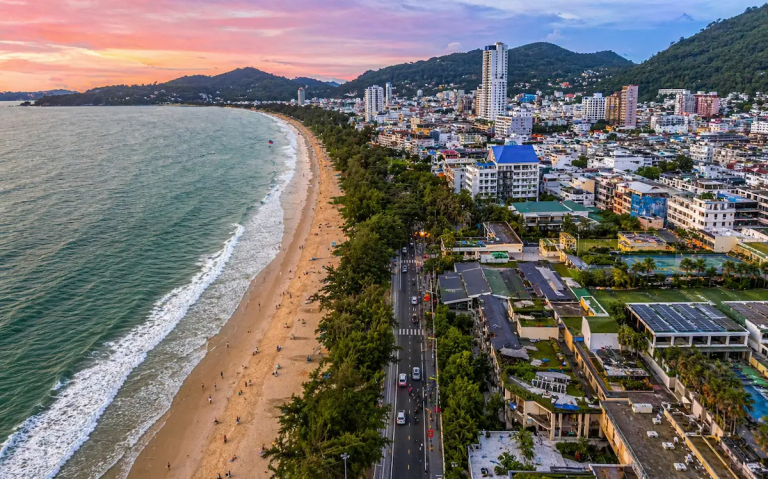
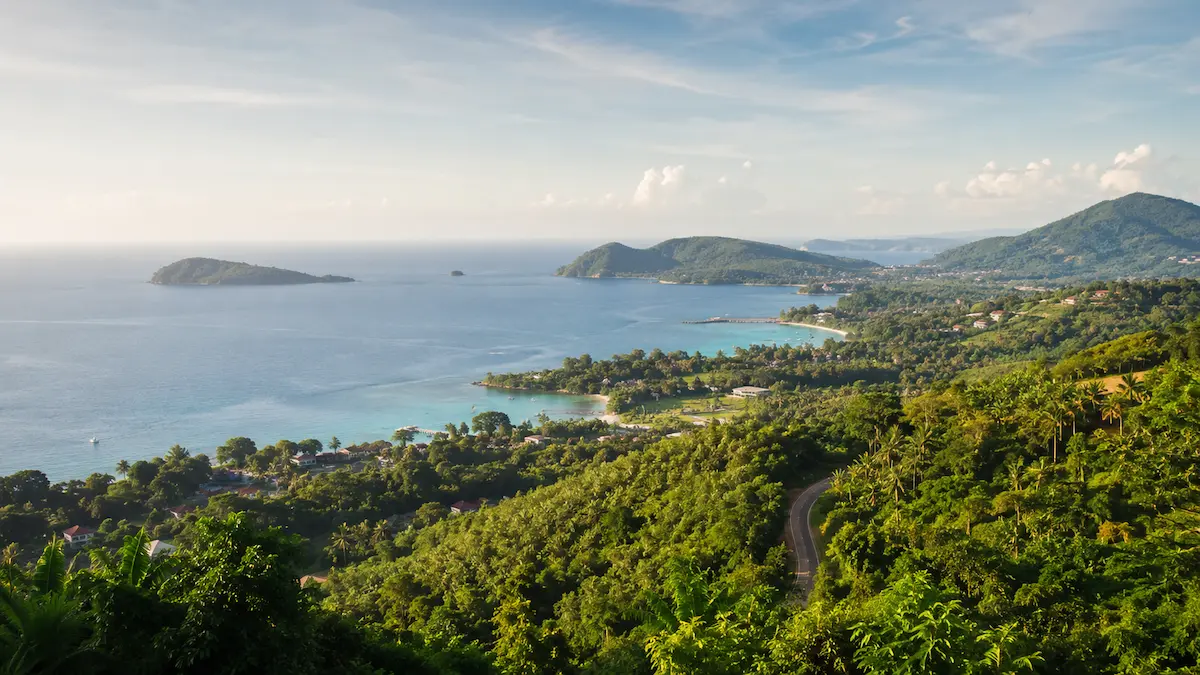
South Phuket has a different rhythm from the island’s main west-coast beach towns. Instead of one dense tourist strip, this part of Phuket is spread across quieter coastal areas, local roads, viewpoints, seafood spots, piers, beaches, and resort pockets. It is not as nightlife-focused as Patong, as straightforward as Kata or Karon, or as polished as Bang Tao and Laguna, but that is exactly why some travellers prefer it.
This part of the island suits people who want a slower, more local-feeling Phuket base. Rawai, Nai Harn, Chalong, Cape Panwa, and Ao Yon each offer something different: beach time, seafood, boat access, sea views, quieter stays, and a more relaxed southern atmosphere. If you are comparing the individual areas, Rawai Beach Guide, Nai Harn Beach Guide, Chalong Guide, Cape Panwa Phuket Guide, and Ao Yon Beach Guide are the natural companion reads.
The trade-off is convenience. South Phuket is not one walkable beach town, and it does not work best if you expect everything to sit directly outside your hotel. Transport matters here, and the area makes more sense when you understand how the different southern pockets connect. If you are still choosing your main base, Where to Stay in Phuket and Phuket Areas Explained are useful guides to read alongside this article.
In this guide, we’ll look at what counts as South Phuket, how Rawai, Nai Harn, Chalong, Cape Panwa, and Ao Yon differ, who should stay here, how transport works, and how this part of the island compares with places like Patong, Kata, Karon, Kamala, Bang Tao, North Phuket, and Phuket Old Town.
What Counts as South Phuket?
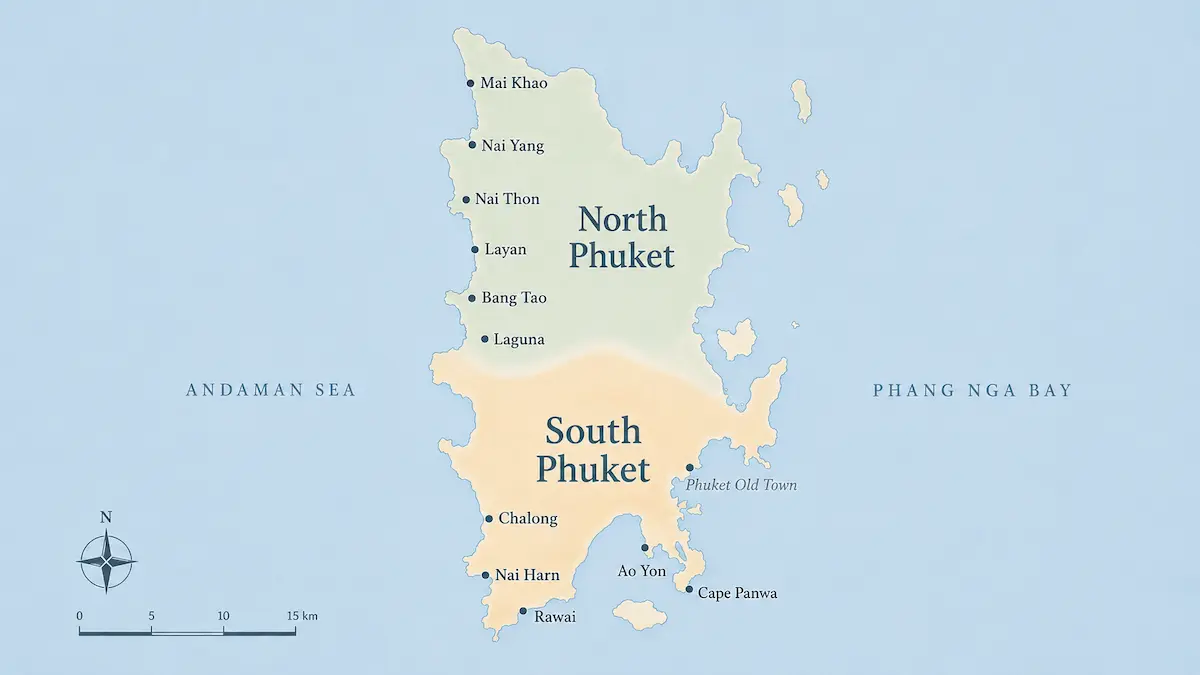
South Phuket usually refers to the southern and southeastern side of the island, especially areas like Rawai, Nai Harn, Chalong, Cape Panwa, and Ao Yon. These places are connected by coastal roads, local neighbourhoods, viewpoints, piers, seafood areas, quieter beaches, and resort pockets rather than one single tourist strip.
Rawai and Nai Harn are often the easiest places to understand first. Rawai has more of a local, long-stay, seafood, and boat-access feel, while Nai Harn is one of the strongest actual beach choices in the south. For more detail on those two areas, Rawai Beach Guide and Nai Harn Beach Guide are the natural companion articles.
Chalong has a different role. It is more of a practical southern hub than a classic beach base, with piers, tours, gyms, local roads, and useful services. Chalong Guide helps explain that side of the area, especially for travellers who want to understand how southern Phuket functions beyond the beaches.
Cape Panwa and Ao Yon sit more toward the southeastern side of Phuket. They feel quieter, more coastal, and more removed from the main west-coast beach circuit. Cape Panwa Phuket Guide explains the wider area, while Ao Yon Beach Guide focuses on one of the calmer beach options nearby.
For this guide, South Phuket does not really mean Kata and Karon, even though they sit toward the lower west coast of the island. Kata and Karon are better understood as classic west-coast beach towns, while this article focuses on the Rawai, Nai Harn, Chalong, Cape Panwa, and Ao Yon cluster.
What Is South Phuket Like?
South Phuket feels more spread out, local, and varied than Phuket’s main beach-town areas. It is not built around one central tourist strip. Instead, the area is shaped by coastal roads, neighbourhoods, beaches, piers, viewpoints, seafood restaurants, cafés, gyms, local services, and quieter resort pockets.
That variety is the main appeal. In South Phuket, you can have a beach day at Nai Harn, a seafood meal in Rawai, a practical stop in Chalong, a quieter resort stay around Cape Panwa, or a calm beach visit at Ao Yon. The area has more moving parts than places like Kata or Karon, but that can make it more interesting for travellers who want a less standard Phuket stay.
The trade-off is that South Phuket is not as simple as choosing one compact beach town. You need to understand distances, transport, and the role each area plays. Rawai is not the same as Nai Harn, Chalong is not really a beach base, and Cape Panwa has a very different feel from the west coast. That is why Phuket Travel Planning Guide and Phuket Travel Costs are useful companion reads for this section.
Compared with areas like Patong, Kata, Karon, Kamala, or Bang Tao, South Phuket feels less like a ready-made holiday strip and more like a part of the island you need to use deliberately. For some travellers, that makes it less convenient. For others, it is exactly what gives the south its character.
Who Should Stay in South Phuket?
South Phuket is best for travellers who want a quieter, more local-feeling base and are comfortable moving around rather than relying on one compact tourist centre. It suits people who like beaches, viewpoints, seafood, cafés, piers, coastal roads, and a slower rhythm than the main west-coast beach towns.
This part of the island can work especially well for repeat Phuket visitors, couples, longer-stay travellers, and people who want to explore Rawai, Nai Harn, Chalong, Cape Panwa, and Ao Yon at a relaxed pace. If your idea of a good Phuket stay involves local restaurants, quiet beach time, scenic drives, and less nightlife pressure, South Phuket may suit you very well.
It is less ideal if you want everything directly outside your hotel. Travellers who want nightlife, dense restaurants, shopping streets, tour desks, and easy walking may prefer areas covered in Patong Beach Guide, Kata Beach Guide, Karon Beach Guide, or Bang Tao Beach Guide.
If this is your first Phuket trip, South Phuket can still work, but it is worth comparing it with First-Time Phuket Guide, Where to Stay in Phuket, Phuket Areas Explained, and Phuket Travel Planning Guide before booking. The south can be rewarding, but it works best when you understand the distances and choose it deliberately.
Rawai
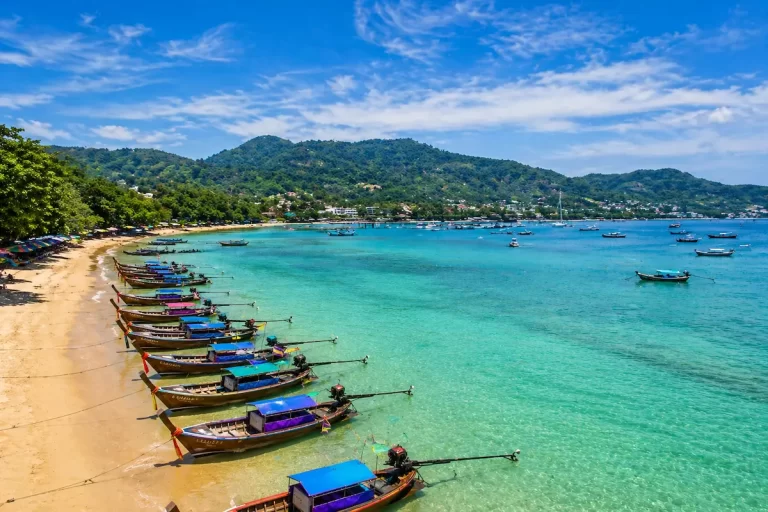
Rawai is one of the main anchors of South Phuket, but it is important to understand what kind of area it is. It is not a classic swimming-beach base like Kata, Karon, or Nai Harn. Instead, Rawai has a more local, long-stay, seafood, pier, and coastal-road atmosphere.
For many travellers, Rawai works best as a base for exploring the south rather than as a place where the beach directly outside your hotel does everything. You are close to seafood restaurants, local cafés, viewpoints, boat trips, Chalong, Nai Harn, and nearby southern routes. That makes Rawai useful if you want movement, variety, and a more grounded Phuket rhythm.
Within South Phuket, Rawai is especially good for repeat visitors and longer-stay travellers who are comfortable using scooters, taxis, private transfers, or rental cars. It gives you access to a lot, but it is not the easiest place if you want to walk everywhere or stay directly beside a main swimming beach.
For a deeper look at this area, Rawai Beach Guide is the natural internal link from this section.
Nai Harn
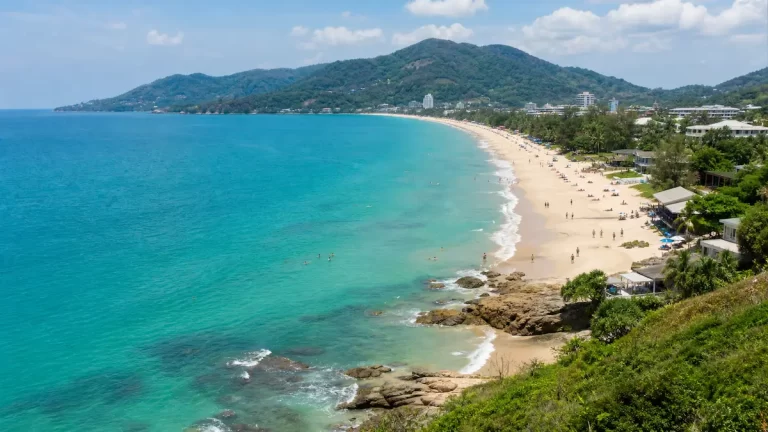
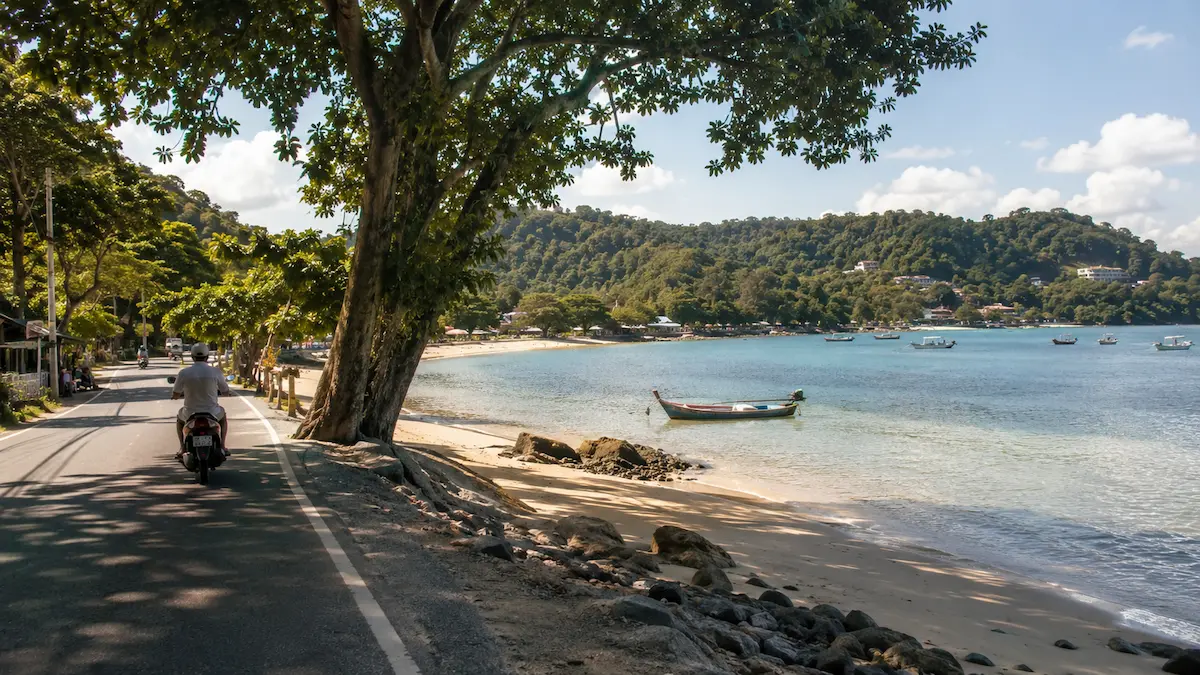
Nai Harn is one of the strongest actual beach choices in South Phuket. Unlike Rawai or Chalong, it works much more clearly as a beach destination, with a scenic bay, a relaxed atmosphere, and a more straightforward beach-day feel.
For travellers who want to stay in the south but still care about swimming, sand, and beach time, Nai Harn is often the easiest area to understand. It feels quieter than Patong, Kata, or Karon, but it still gives you a proper beach experience. That makes it useful for couples, relaxed families, and repeat visitors who want a calmer southern base.
Within South Phuket, Nai Harn pairs naturally with Rawai. Many travellers stay around Rawai for restaurants, seafood, cafés, and local movement, then use Nai Harn for beach time. This combination is one of the reasons the southern part of the island appeals to people who want more than a simple resort strip.
For a fuller look at the beach, atmosphere, transport, and who it suits, Nai Harn Beach Guide is the best internal link from this section.
Chalong
Chalong plays a more practical role in South Phuket. It is not usually the area travellers choose for a classic beach holiday, but it is important because of its piers, tour access, gyms, local roads, services, and connections to Rawai, Nai Harn, Phuket Town, and the wider south.
For many visitors, Chalong is useful rather than scenic. It can work well if you are planning boat trips, diving, fitness stays, longer visits, or regular movement around southern Phuket. It is also one of those areas that helps you understand how the island functions beyond the obvious beach towns.
Within South Phuket, Chalong acts like a connector. It links Rawai and Nai Harn with Phuket Town, Cape Panwa, Ao Yon, and parts of the east coast. That makes it practical, but not always the most appealing choice if your main goal is to wake up beside a swimming beach.
For travellers who want to understand this area properly, Chalong Guide is the natural internal link from this section. It explains why Chalong matters, who it suits, and why it is better treated as a functional southern hub than a typical beach base.
Cape Panwa
Cape Panwa is the quieter southeastern side of South Phuket, with a very different feel from Rawai, Nai Harn, or Chalong. It is more resort-focused, more tucked away, and better suited to travellers who want sea views, slower days, and a calmer coastal base rather than nightlife or constant movement.
This area can work well for couples and relaxed families who want comfort, quiet, and a more self-contained stay. Cape Panwa is not the most convenient base if you plan to visit Patong, Kata, Karon, or Bang Tao often, but it can be a good choice if your trip is focused on southeast Phuket, Phuket Town, Chalong, Rawai, Nai Harn, or Ao Yon.
Within South Phuket, Cape Panwa gives the region a softer resort-and-sea-view option. It is less local and active than Rawai, less beach-focused than Nai Harn, and less practical than Chalong, but it has its own appeal for travellers who want peace and scenery.
For a deeper look at the area, Cape Panwa Phuket Guide is the natural internal link from this section. It explains the atmosphere, beaches, transport trade-offs, and who should consider staying there.
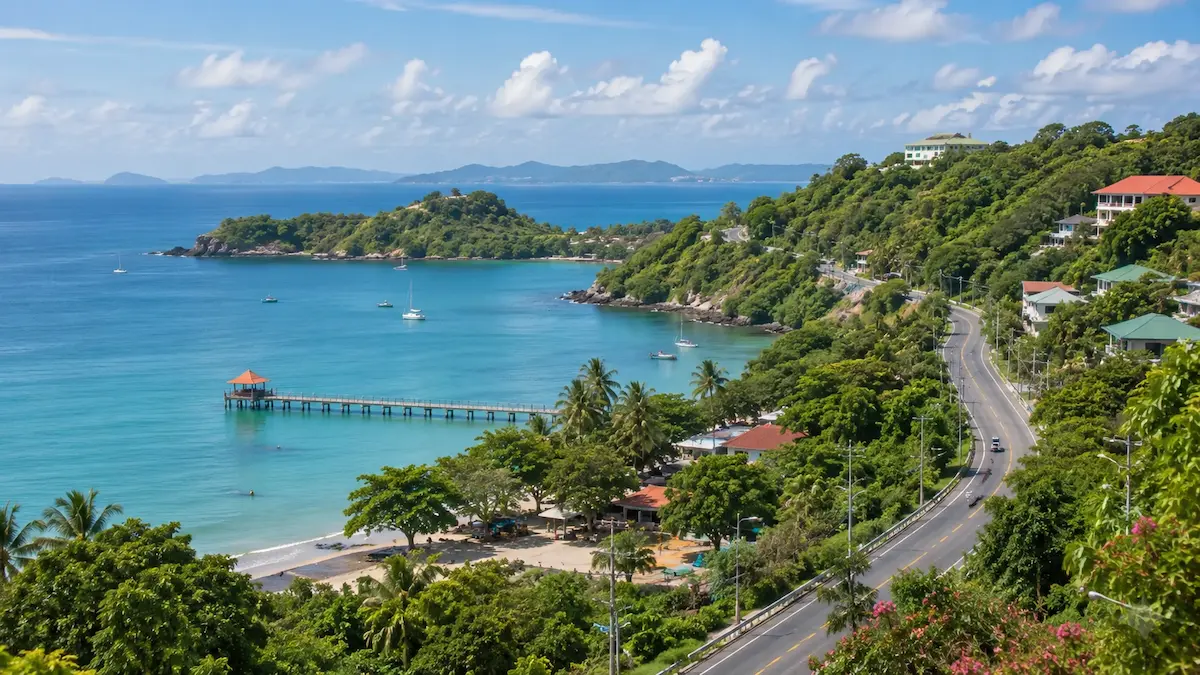
Ao Yon Beach
Ao Yon Beach adds a quieter beach option to the southeastern side of South Phuket. It sits near Cape Panwa and feels calmer and more local-style than Phuket’s better-known west-coast beaches. It is not a big nightlife or shopping area, but it can be a lovely place for slower beach time.
For travellers staying around Cape Panwa, Phuket Town, Chalong, Rawai, or Nai Harn, Ao Yon can make sense as part of a relaxed southern or southeastern Phuket day. It is usually less practical as a quick beach stop from Patong, Kata, Karon, or Bang Tao unless it fits naturally into your route.
Within South Phuket, Ao Yon works best as a calm beach companion to Cape Panwa. Cape Panwa gives you the wider resort and coastal area, while Ao Yon gives you a more specific beach experience nearby.
For more detail on the beach itself, Ao Yon Beach Guide is the natural internal link from this section. It explains the atmosphere, swimming conditions, transport, and whether Ao Yon is worth visiting for your style of trip.
South Phuket vs Kata and Karon
South Phuket is different from Kata and Karon, even though they all sit toward the lower half of the island. Kata and Karon are better understood as classic west-coast beach towns, while South Phuket is more spread out, local-feeling, and varied.
Kata is usually better if you want a compact beach area with restaurants, cafés, surf-season atmosphere, and easier access to both Karon and Patong. Karon is better if you want a long beach, a more straightforward holiday setup, and a familiar west-coast base. For those comparisons, Kata Beach Guide, Karon Beach Guide, and Kata vs Karon are useful companion reads.
South Phuket works differently. Rawai, Nai Harn, Chalong, Cape Panwa, and Ao Yon do not function as one simple beach strip. You get more variety, but you also need more planning. The area can suit travellers who want seafood, viewpoints, piers, quieter beaches, local roads, and a slower southern rhythm.
If this is your first Phuket trip and you want an easy beach-town base, Kata or Karon may be simpler. If you want a more flexible southern base and are comfortable with transport, South Phuket may feel more interesting. For travellers still comparing the classic west-coast route, Patong vs Kata vs Karon is also worth linking here.
Is South Phuket Good for Families?
South Phuket can be good for families, but it depends on the kind of family holiday you want. This part of the island works better for relaxed families who are comfortable with transport, quieter days, and a less central beach-town setup.
Nai Harn is usually the strongest family-friendly beach option in South Phuket. It gives families a proper beach setting, a scenic bay, and a calmer atmosphere than places like Patong. If beach time is the priority, Nai Harn Beach Guide is the most useful companion article to link from this section.
Cape Panwa can also work well for families who want a quieter resort-style stay. It is less convenient than Kata, Karon, Kamala, or Bang Tao, but it can suit families who prefer pools, sea views, slower days, and a more self-contained base. For that style of trip, Cape Panwa Phuket Guide is worth comparing.
Rawai can work for longer-stay families or families who like local restaurants, seafood, cafés, and easy access to Nai Harn, but it is not a classic swimming-beach base. Chalong is practical for tours, gyms, services, and movement, but it is usually not the first choice for a family beach holiday.
If your family wants more convenience, walkability, restaurants, and resort infrastructure, Karon Beach Guide, Kamala Beach Guide, Bang Tao Beach Guide, and Laguna Phuket and Cherng Talay Guide may be better comparisons. South Phuket is family-friendly when you choose it deliberately, but it is not the easiest default choice for every family.
Is South Phuket Good for Couples?
South Phuket can be a very good choice for couples who want a slower, more varied Phuket stay. It suits travellers who care more about beaches, viewpoints, local restaurants, seafood, quiet coastal roads, and relaxed days than nightlife or staying in the middle of the busiest tourist areas.
Nai Harn is one of the strongest options for couples who want a scenic beach atmosphere without the intensity of Patong, Kata, or Karon. Rawai can work well if you like local dining, seafood, cafés, and a more lived-in southern rhythm. For that combination, Nai Harn Beach Guide and Rawai Beach Guide are useful companion reads.
Cape Panwa is better for couples who want a quieter resort-style stay with sea views and a more tucked-away feel. Ao Yon can add a calm beach option nearby, especially if you are already exploring the southeastern side of the island. For that style of trip, Cape Panwa Phuket Guide and Ao Yon Beach Guide are the natural links.
The main trade-off is convenience. South Phuket is romantic in a slower, quieter way, not in a nightlife-heavy or highly polished resort-district way. If you want more restaurants, beach clubs, shopping, and lifestyle convenience nearby, Kamala Beach Guide or Laguna Phuket and Cherng Talay Guide may be better comparisons.
Getting Around South Phuket
Getting around South Phuket takes some planning because the area is spread out. Rawai, Nai Harn, Chalong, Cape Panwa, and Ao Yon are connected, but they are not one compact walking zone. You can move between them fairly easily with transport, but you should not expect everything to sit directly outside your hotel.
This is where South Phuket differs from a more straightforward beach-town stay. In places like Kata, Karon, or Kamala, many travellers can build more of their day around walking between the beach, restaurants, shops, and hotels. In the south, you are more likely to rely on taxis, private transfers, scooters, rental cars, or arranged transport.
That is not necessarily a bad thing. If you are comfortable moving around, South Phuket gives you a lot of variety: Nai Harn for beach time, Rawai for seafood and local rhythm, Chalong for piers and practical services, Cape Panwa for sea-view resort stays, and Ao Yon for a quieter beach stop. But the area works best when you plan your movement rather than assuming everything will be easy on arrival.
If you are still shaping your route, Phuket Travel Planning Guide, Phuket Travel Costs, Phuket Mistakes First Timers Make, How Many Days in Phuket, and Phuket Itinerary are useful companion reads. Transport, timing, and base choice matter a lot in South Phuket, especially if you also plan to visit Patong, Bang Tao, North Phuket, or Phuket Old Town during the same trip.
South Phuket vs Other Phuket Areas
South Phuket is easiest to understand when you compare it with the rest of the island. It is not the most convenient, nightlife-heavy, or polished resort area in Phuket. Its strength is variety: beaches, viewpoints, seafood, piers, local roads, quiet coastal pockets, and a slower southern rhythm.
South Phuket vs Patong
Patong is better if you want nightlife, shopping, restaurants, beach activity, and constant movement around you. It is the more convenient choice for travellers who want Phuket’s busiest tourist scene and do not mind crowds.
South Phuket is much quieter and more spread out. It suits travellers who want local atmosphere, beaches like Nai Harn, seafood in Rawai, practical access through Chalong, or quiet resort time around Cape Panwa. For a realistic contrast, Patong Beach Guide and Patong Beach Phuket: What the Area Is Really Like are useful companion reads.
South Phuket vs Kamala
Kamala is a calmer west-coast beach town with more straightforward beach-stay convenience. It has hotels, restaurants, beach access, and a more familiar holiday layout than most of South Phuket.
South Phuket is more varied but less simple. It gives you Rawai, Nai Harn, Chalong, Cape Panwa, and Ao Yon, but these areas are spread out and work best with transport. If you want quiet with easier beach-town structure, Kamala Beach Guide is worth comparing.
South Phuket vs Bang Tao and Laguna
Bang Tao and Laguna are more polished, resort-focused, and lifestyle-driven. They are better if you want beach access, villas, restaurants, cafés, resorts, and a more organised holiday environment.
South Phuket feels more local and varied. It is better for travellers who want Rawai seafood, Nai Harn beach time, Chalong piers, Cape Panwa sea views, or Ao Yon’s quieter beach atmosphere. If you are comparing comfort and convenience with southern variety, Bang Tao Beach Guide and Laguna Phuket and Cherng Talay Guide are natural links.
South Phuket vs North Phuket
North Phuket is quieter, more spacious, and more airport-friendly. It suits travellers who want resort stays, long beaches, fewer crowds, and a slower start or finish to their trip.
South Phuket is also quiet in parts, but it has more varied local movement. Rawai, Nai Harn, Chalong, Cape Panwa, and Ao Yon give the south a different rhythm, with beaches, piers, seafood, viewpoints, and local roads all playing a role. For that comparison, North Phuket Guide is the best companion article.
South Phuket vs Phuket Old Town
Phuket Old Town is better for food, cafés, heritage streets, markets, architecture, and urban atmosphere. It is not a beach base, but it gives travellers a completely different side of the island.
South Phuket is better if you want beaches, viewpoints, seafood, piers, coastal roads, and quieter stays. If you are choosing between cultural atmosphere and southern coastal movement, Phuket Old Town Guide is the natural comparison.
Pros and Cons of Staying in South Phuket
Like any Phuket base, South Phuket works best when the area matches the kind of trip you actually want. It can be interesting, varied, and more local-feeling than many beach resort areas, but it is not the easiest choice for every traveller.
Pros of Staying in South Phuket
The biggest advantage of South Phuket is variety. You are not limited to one beach or one resort strip. You can use Nai Harn for beach time, Rawai for seafood and local rhythm, Chalong for piers and practical access, Cape Panwa for quiet resort stays, and Ao Yon for a calmer southeast beach experience.
South Phuket also feels less intense than Phuket’s busiest tourist areas. It can suit travellers who want a slower pace, more local atmosphere, quieter coastal roads, viewpoints, cafés, and a better sense of how the southern side of the island works beyond the main holiday strips.
Another strength is that South Phuket can be very rewarding for repeat visitors and longer-stay travellers. Once you understand the distances and movement, the area gives you access to beaches, piers, restaurants, local services, and quieter places that are harder to appreciate on a rushed first trip.
Cons of Staying in South Phuket
The main downside of South Phuket is that it is spread out. Rawai, Nai Harn, Chalong, Cape Panwa, and Ao Yon are connected, but they are not one simple walkable area. If you expect everything to be directly outside your hotel, the south can feel confusing.
Transport matters here. South Phuket works much better if you are comfortable using taxis, private transfers, scooters, rental cars, or planned transport. Without that, the area can feel less convenient than Kata, Karon, Kamala, Bang Tao, or Patong.
The final trade-off is that South Phuket is not always the easiest choice for first-time visitors. It has excellent pockets, but not every area is a classic beach base. Rawai is not mainly a swimming beach, Chalong is practical rather than scenic, and Cape Panwa is quiet but less central. If you want the simplest first-time Phuket beach holiday, another area may suit you better.
How Long Should You Stay in South Phuket?
How long you should stay in South Phuket depends on whether you are using it as your main base or as part of a split Phuket trip. This part of the island works best when you have time to move slowly, understand the distances, and enjoy the different pockets rather than rushing between them.
For one or two nights, South Phuket can work if you have a specific reason to be there, such as a tour from Chalong, a quiet stay around Cape Panwa, or a short Rawai and Nai Harn visit. But for most travellers, one night may feel too short to understand the area properly.
For three or four nights, South Phuket starts to make more sense. That gives you time for Nai Harn beach, Rawai seafood, Cape Panwa or Ao Yon, a Chalong-based activity, and some slower movement through the southern side of the island. This length works well for couples, relaxed families, repeat visitors, and travellers who want a less standard Phuket stay.
A full stay in South Phuket is best for travellers who deliberately want the southern rhythm and do not need nightlife, dense shopping, or easy access to every major beach area. If you also want Patong, Kata, Karon, Bang Tao, North Phuket, or Phuket Old Town, a split stay may work better. For planning that balance, How Many Days in Phuket, Phuket Itinerary, and Where to Stay in Phuket are useful companion guides.
Should You Stay in South Phuket?
You should stay in South Phuket if you want a quieter, more local-feeling Phuket base with access to Rawai, Nai Harn, Chalong, Cape Panwa, Ao Yon, viewpoints, seafood, piers, and slower coastal routes. It suits travellers who want variety and atmosphere more than nightlife or a simple resort strip.
South Phuket is especially useful for repeat visitors, couples, longer-stay travellers, and people who are comfortable using transport. If you like the idea of spending one day at Nai Harn, another around Rawai, another exploring Cape Panwa or Ao Yon, and another using Chalong as a practical hub, the area can work very well.
You may want to choose somewhere else if this is your first Phuket trip and you want the easiest possible base. Patong, Kata, Karon, Kamala, Bang Tao, or Laguna may be more straightforward if you want walkability, restaurants, shopping, and tourist facilities close by. For broader comparison, Where to Stay in Phuket, Phuket Areas Explained, and Best Beaches in Phuket are useful companion reads.
The simple answer is this: South Phuket is a good choice when you want a slower, more flexible, more local-feeling stay. It is not the most convenient part of the island, but for the right traveller, that southern rhythm is exactly the appeal.
Not sure whether South Phuket is the right base for your trip? The south can be rewarding, but it works best when the area matches your pace, transport plans, and expectations.
For help choosing between South Phuket, Kata, Karon, Bang Tao, North Phuket, or another part of the island, you can use the free Phuket planning resources from Resurgence Travel or get support shaping a Phuket holiday around the beaches, areas, and experiences that actually suit the way you want to travel.
FAQs About South Phuket
Is South Phuket a good place to stay?
Yes, South Phuket is a good place to stay if you want a quieter, more local-feeling base with access to Rawai, Nai Harn, Chalong, Cape Panwa, Ao Yon, viewpoints, seafood, and coastal roads. It works best for travellers who are comfortable moving around rather than staying in one compact beach town.
What areas are in South Phuket?
The main South Phuket areas covered in this guide are Rawai, Nai Harn, Chalong, Cape Panwa, and Ao Yon. These areas are connected, but they each have a different role. Rawai is local and coastal, Nai Harn is the main beach choice, Chalong is practical, Cape Panwa is quieter and resort-focused, and Ao Yon is a calmer southeast beach.
Is South Phuket good for first-time visitors?
South Phuket can work for first-time visitors, but it is usually better for travellers who already understand Phuket or deliberately want a quieter stay. First-time visitors who want nightlife, easy walking, lots of restaurants, and a classic beach-town base may prefer Patong, Kata, Karon, Kamala, Bang Tao, or Laguna.
Is South Phuket good for families?
Yes, South Phuket can suit relaxed families, especially around Nai Harn or Cape Panwa. Nai Harn gives families a proper beach option, while Cape Panwa can work for quieter resort-style stays. Families wanting more restaurants, walkability, and resort infrastructure may prefer Karon, Kamala, Bang Tao, or Laguna.
Is South Phuket better than North Phuket?
Not generally — it depends on your trip. South Phuket is better for Rawai, Nai Harn, Chalong, Cape Panwa, Ao Yon, seafood, piers, viewpoints, and southern coastal movement. North Phuket is better for airport convenience, spacious beaches, quiet resort stays, and a slower northern beach atmosphere.
Do you need transport in South Phuket?
Yes, transport helps a lot in South Phuket. Rawai, Nai Harn, Chalong, Cape Panwa, and Ao Yon are spread out, so taxis, private transfers, scooters, or rental cars make the area much easier to enjoy. Without transport, the south can feel less convenient than more compact beach-town areas.
About the Author
David Hibbins is a Phuket-based travel writer and publisher with long-term experience exploring the island’s beaches, neighbourhoods, travel routes, and visitor decision points. Through Go Find Asia and the wider Travel With Insight publishing ecosystem, he creates practical Phuket guides that help travellers choose the right base, understand local trade-offs, and plan holidays that match how they actually want to travel.
This South Phuket guide is written to help travellers understand how Rawai, Nai Harn, Chalong, Cape Panwa, and Ao Yon fit together as a southern Phuket travel zone. The focus is on clear local context, realistic planning advice, and helping readers decide whether South Phuket suits their pace, transport plans, expectations, and overall Phuket itinerary.