
The Two Women Who Saved Phuket: The Heroines of Thalang
Most people arrive in Phuket expecting a certain version of the island.
Beaches lined with umbrellas. Long-tail boats drifting across clear water. Nights that stretch later than planned, and mornings that start slowly because of it.
Everything about Phuket feels established—almost inevitable—as if it has always existed exactly like this.
But that version of the island is recent.
Long before the resorts, before the airport, before Phuket became one of Southeast Asia’s most visited destinations, this was a place exposed to real threat. Not hypothetical, not distant—but immediate and unavoidable.
There was a moment when Phuket was vulnerable, underprepared, and on the edge of being taken.
And if things had gone differently, the island you see today—its culture, its identity, even its place on the map—might not exist in the same way at all.
The story of the Heroines of Thalang is one of the most important moments in Phuket’s history—and one most visitors never hear.
Phuket in 1785
In 1785, Phuket was not a destination.
It was a frontier.
Known then as Thalang, the island held importance not because of beauty, but because of what it produced and where it sat. Tin mining had made it valuable, and its position along key trade routes gave it quiet strategic weight in the region.
But it was not heavily defended.
Phuket sat on the outer edge of Siam’s influence, far from central power, and like many outposts of the time, it depended on local leadership to maintain order and security.
And at the worst possible moment, that leadership disappeared.
The island’s governor had recently died, leaving a gap that had not yet been filled. There was no clear chain of command, no organised military structure, and no coordinated plan for defence.
Under normal conditions, that might have been manageable.
But these were not normal conditions.
Across the region, conflict was already underway. Forces were moving. Territories were being tested. And islands like Phuket—valuable, exposed, and lightly defended—were exactly the kind of places that became targets.
The Threat Arrives
By early 1785, the wider conflict had already begun.
The campaign later known as the Burmese–Siamese War (1785–1786) was pushing into multiple regions at once. Burmese forces were advancing with coordination and intent, targeting positions that were valuable, exposed, and realistically defendable.
Phuket—then Thalang—fit that description.
The approach came from the sea.
Burmese forces moved along the Andaman coast and toward the island, using naval transport to project strength quickly into areas that were not prepared for direct assault. Landing forces in this way allowed them to bypass slower land routes and strike where resistance was weakest.
And when they arrived, the situation on the island had not improved.
There was still no formal leadership structure in place. No standing army positioned to respond. No reinforced defensive lines ready for sustained attack.
What Phuket had instead was time running out.
The expectation—based on everything that had already happened across the region—was straightforward.
The Burmese would land, apply pressure, and take control.
There was no reason to believe this situation would unfold differently from others.
At this point in the story, nothing suggested that Phuket would hold.
And nothing suggested that the people who would change that outcome had already decided to act.
The Turning Point — The Heroines of Thalang Step In
At the point where Phuket should have started to fall, something shifted.
Not because reinforcements arrived.
Not because the situation improved.
But because two people chose to act.
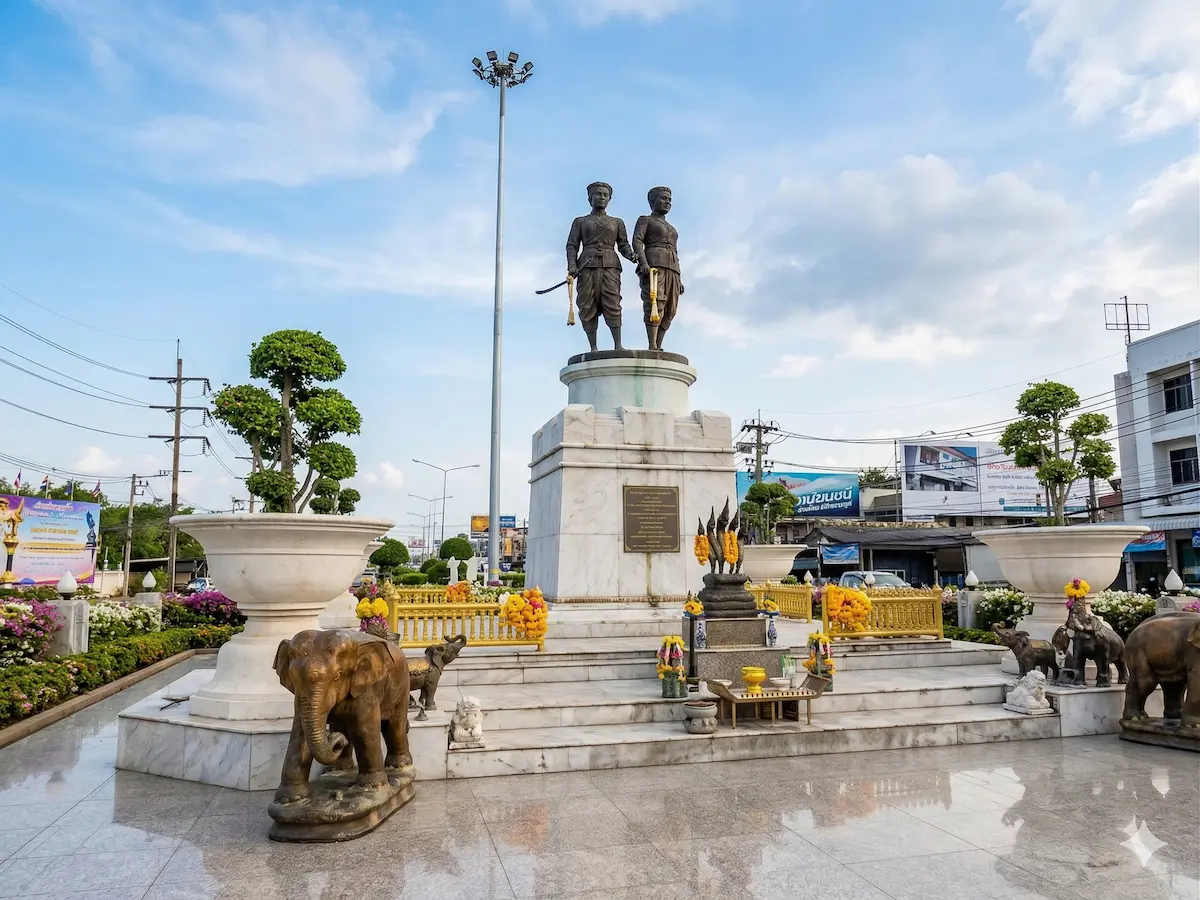
The responsibility fell to Thao Thep Kasattri, known at the time as Lady Chan, and her sister Thao Sri Sunthon.
They were not military commanders in the traditional sense. They had not been appointed to lead an army, and there was no formal structure waiting for them to step into.
What they had was proximity to the problem—and a clear understanding of what would happen if nothing was done.
With no governor in place and no organised defence, the decision was simple in theory but difficult in reality.
Either wait for an outcome that had already played out elsewhere.
Or take control of a situation that was not designed for them to control.
They chose the second.
There was no signal that help would arrive in time. No certainty that resistance would succeed.
But in that moment, the absence of leadership became the reason they stepped forward.
And from that point on, the defence of Phuket was no longer undefined.
It had direction.
Building a Defence
Once the decision was made, the problem became immediate.
There was no army to command.
No trained force waiting to be deployed.
If Phuket was going to hold, it would have to be built from what was already there.
The sisters began organising the local population into a defensive force.
Villagers, workers, traders—anyone capable of contributing was drawn into the effort. What they lacked in formal training, they made up for in numbers, familiarity with the land, and the simple fact that there was nowhere else to go.
Defensive positions were established around Thalang.
Natural terrain was used where possible. Movement was controlled. The objective was not to defeat a larger invading force outright, but to hold long enough to change the situation.
Structure started to replace uncertainty.
People were given roles. Positions were assigned. The idea of resistance—uncertain at first—began to take shape as something organised.
But even with that, the imbalance remained.
The Burmese forces were still larger, more experienced, and better equipped.
Holding ground would not be enough on its own.
If Phuket was going to survive, it needed something more than numbers.
It needed to change how the situation looked from the outside.
The Strategy — Perception Over Strength
By this point, the situation was clear.
Phuket could organise a defence.
But it could not match the Burmese forces in size, training, or equipment.
If the outcome depended purely on strength, the result was predictable.
So the sisters shifted the terms of the conflict.
Instead of trying to become stronger, they focused on how they were seen.
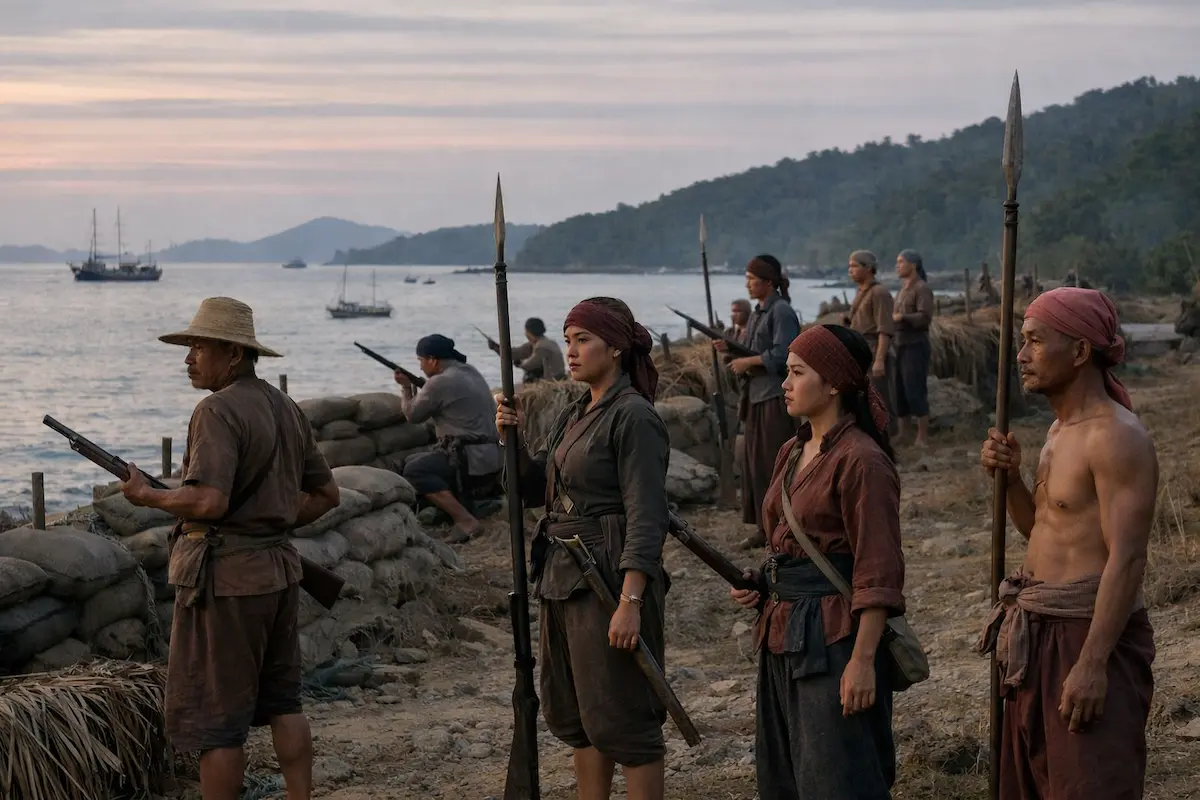
One of the most effective tactics attributed to their leadership was the deliberate manipulation of appearance. Women were dressed as soldiers and positioned along defensive lines, increasing the visible size of the force from a distance.
This was not a single staged moment.
It was a repeated, controlled presentation.
Movement along the defences was made visible. Positions were occupied in ways that suggested depth. The same individuals could be repositioned to create the impression of rotation and scale.
From the outside, the defending force appeared larger, more organised, and more prepared than it actually was.
And that mattered.
In a campaign like this, invading forces were constantly assessing risk. An easy advance was one thing. A prolonged engagement against a force that appeared structured and capable was something else entirely.
What the sisters created was uncertainty.
Not enough to end the conflict immediately—but enough to disrupt expectation.
And once expectation is disrupted, decisions change.
The Burmese were no longer looking at an undefended outpost.
They were looking at a resistance that did not match what they had anticipated.
And that shift—subtle at first—began to influence everything that followed.
The Siege — Holding Under Pressure
What followed was not a single decisive battle.
It was a period of sustained pressure.
The Burmese had landed with the expectation of a relatively quick advance. Instead, they were met with resistance that held its shape day after day. Defensive positions remained occupied. Movement continued along the lines. The appearance of organisation did not break.
For those on the island, the situation was far less certain.
There was no clear indication of how long they could hold. Supplies were limited. Fatigue would have set in quickly. And at any point, a coordinated assault from a stronger force could have broken through.
But it didn’t.
The defence held.
Time passed, and that began to matter more than anything else.
Because every day that Phuket did not fall, the situation became less predictable for the attackers. What was expected to be straightforward was turning into something extended.
And extended conflicts carry risk.
From the outside, the Burmese were now facing a position that appeared stable, reinforced, and prepared to continue resisting. The longer that perception held, the less attractive a full commitment to the assault became.
Inside the defence, the objective remained simple.
Hold.
Not win outright. Not push forward.
Just hold long enough for the situation to change.
And gradually, it did.
The Withdrawal — Why the Burmese Pulled Back
In the end, Phuket was not taken.
Not because the defending force suddenly became stronger, and not because a decisive battle turned the outcome.
The shift came from accumulation.
The resistance had held longer than expected. The defending force appeared more organised than anticipated. And what should have been a straightforward advance had turned into a prolonged engagement with unclear cost.
For the Burmese, the calculation changed.
Continuing the assault meant committing more time, more resources, and more risk to a position that was no longer predictable. And in a wider campaign that extended across multiple regions, that kind of uncertainty carried weight.
So the decision was made to withdraw.
Phuket remained under Siamese control.
Not through overwhelming strength, but through a defence that altered how the situation was perceived—and held long enough for that shift to matter.
Legacy — What Remains Today
Today, the story hasn’t disappeared, the Heroines of Thalang are remembered across Phuket
It just sits quietly in plain sight.
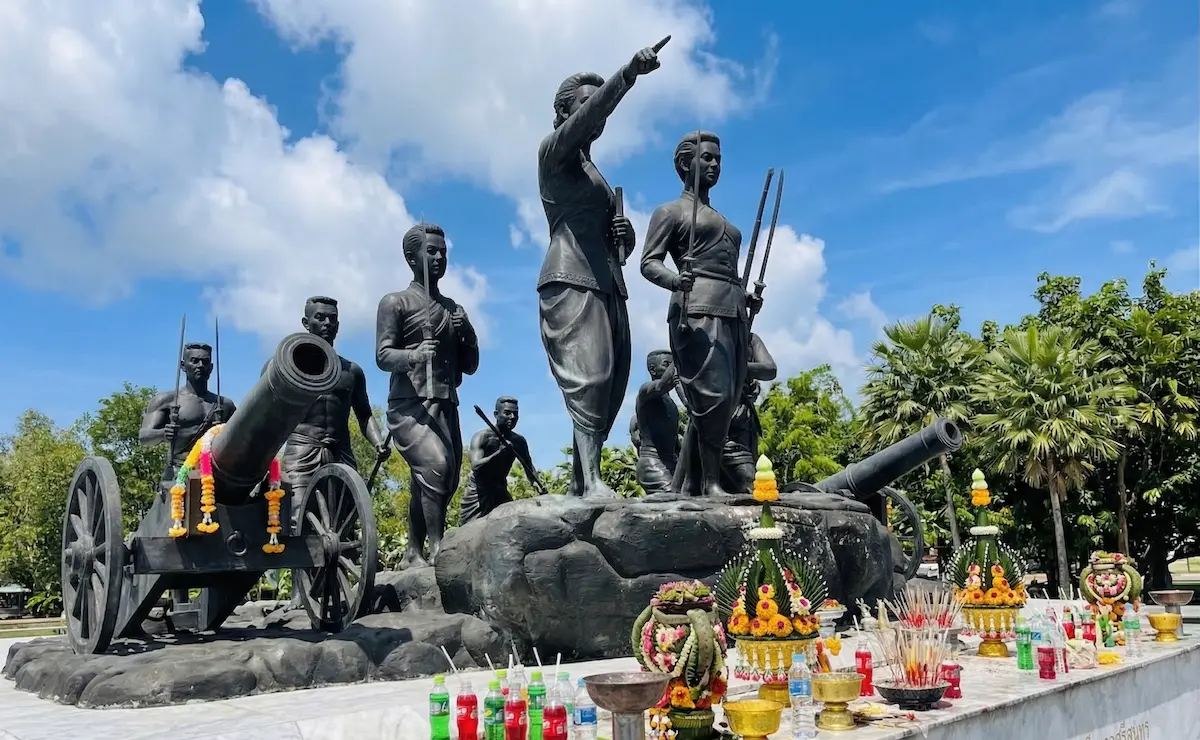
The Heroines Monument stands in the centre of a busy roundabout in Thalang, marking the place where the island’s defence is remembered. Two figures stand side by side—recognisable across Thailand, but often overlooked by those passing through.
Locally, the story is not treated as a legend.
It’s part of recorded history.
Each year, Phuket commemorates the event during the Thao Thep Kasattri–Thao Sri Sunthon Festival, recognising the role the two sisters played in holding the island.
But outside of that, the monument is easy to miss.
Traffic moves around it. Tours pass by. Most visitors continue without stopping, unaware that the island they’re exploring was once defended at that exact point.
What Travelers Miss
Most trips to Phuket are built around movement.
Where to go next. Which beach to visit. What to fit into the day before it ends.
And it’s easy to experience the island entirely at that level—moving from place to place without ever needing to understand what came before.
But places aren’t just locations.
They’re outcomes.
If you’re starting to explore Phuket beyond the surface level, it helps to understand how the island is actually structured day to day.
You can explore different routes, practical itineraries, and movement across the island in our
👉 Phuket day trips and tour ideas
Phuket looks the way it does today because of decisions made at specific moments in time—some visible, most not. The story of the Heroines of Thalang is one of those moments.
It doesn’t change your itinerary.
You don’t need to plan your day around it.
But once you know it, something shifts.
You pass through the island differently. You notice things you would have ignored. A monument becomes more than a landmark. A place becomes more than a backdrop.
And the experience—quietly—becomes something deeper than just being there.
If you want to go a step further, we’ve put together a simple free Phuket guide that breaks down where to stay, how to move around the island, and how to plan your time without wasting days.
You can access it here:
👉 free Phuket guide
Frequently Asked Questions About the Heroines of Thalang
Who were the Heroines of Thalang?
The Heroines of Thalang were two sisters, Thao Thep Kasattri (Lady Chan) and Thao Sri Sunthon (Lady Mook), who led the defence of Phuket against a Burmese invasion in 1785.
What did the Heroines of Thalang do?
They organised local villagers into a defensive force and used strategic deception, including making their numbers appear larger, to resist the Burmese attack.
Where is the Heroines Monument in Phuket?
The Heroines Monument is located in Thalang in northern Phuket, near the main road between Phuket Airport and Patong.
When did the battle for Phuket take place?
The defence of Phuket took place in 1785 during the Burmese–Siamese War, also known as the Nine Armies War.
Why are the Heroines of Thalang important?
They are remembered for leading a successful resistance that prevented Phuket from falling, shaping the island’s history and identity.